
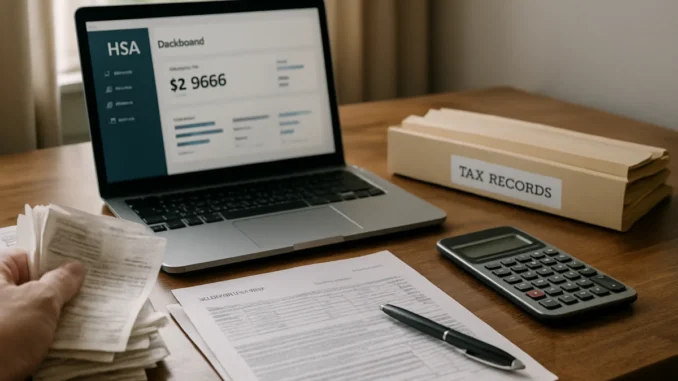
Millions of Americans who use health savings accounts are sitting on a tax advantage that comes with a catch: if they want to reimburse themselves years later for old medical bills, they must be able to prove every expense was qualified. The IRS can ask for receipts, and if the paper trail is missing, account holders can face taxes and penalties on what they thought was a clean withdrawal.
Why HSAs create a unique documentation burden
Health savings accounts are designed to do two things at once. They let people pay current medical expenses with pretax dollars, and they let unused money grow for future healthcare costs.
That flexibility is what makes HSAs attractive to workers enrolled in high-deductible health plans. It is also what makes them unusually hard to track. Unlike a typical spending account, an HSA can sit untouched for years, then be tapped later to cover a bill that was paid long ago out of pocket.
That delayed reimbursement strategy is legal, but it depends on evidence. The account holder has to show that the expense was qualified, that it was not reimbursed elsewhere, and that it was incurred after the HSA was opened, according to IRS Publication 969 and Publication 502.
The IRS rule behind the risk
The basic rule sounds simple. Money taken from an HSA is tax-free only if it is used for qualified medical expenses. The IRS lists those expenses in Publication 502, which covers doctor visits, prescriptions, dental care, vision care and many other medical costs.
The harder part is timing and proof. The IRS does not give taxpayers a special shortcut for old bills, and it does not require providers to keep those records for HSA owners. That means the burden falls on the consumer to retain receipts, explanations of benefits, bank records and any other documents that establish the expense.
This is where the system becomes fragile. Medical offices close, insurers change portals, and paper receipts fade. People often assume that because an HSA administrator can show the withdrawal, the tax question is settled. It is not. The IRS still wants documentation of the expense itself.
Tax advisers say that is why a later reimbursement can become a problem years after the original purchase. If the paperwork is gone, the account owner may have to treat the withdrawal as taxable income. If the person is under 65, an additional 20 percent penalty can apply to nonqualified distributions.
What account holders often get wrong
The most common mistake is treating an HSA like a regular checking account. Consumers use the card at the pharmacy or the dentist, then throw away the receipt because the bill has already been paid.
That habit can erase a future tax-free reimbursement opportunity. Some account owners keep only a credit card statement, but that usually does not show enough detail to prove the expense was medical and qualified under IRS rules.
Another error is assuming the HSA provider will store everything forever. Many administrators keep transaction histories, but they are not responsible for maintaining a full tax record. Statements can disappear after account transfers, plan changes or employer transitions.
People also misread the flexibility of HSAs as a reason to ignore other tax rules. If a medical expense was already deducted on an itemized return, it generally cannot be reimbursed tax-free again from an HSA. The same expense cannot be used twice for tax benefits.
For families, the record-keeping challenge gets bigger. Receipts may cover a spouse or dependent, and those expenses can still qualify, but only if the taxpayer can show who incurred the bill and when. That adds another layer of detail to preserve.
How experts recommend organizing the paper trail
Financial planners and tax professionals generally advise HSA owners to build a separate documentation system instead of relying on memory or the health plan portal. The goal is not to make tax filing easier once a year. It is to preserve evidence for the day a reimbursement is finally requested.
The simplest approach is digital. Scan or photograph every eligible receipt, then save it with the date, provider name, amount and a note that it was paid out of pocket. Many advisers also recommend storing the related explanation of benefits and proof of payment in the same folder.
A spreadsheet can help too. It can track the service date, expense type, recipient and whether the bill has already been reimbursed from any source. That reduces the risk of duplicate claims, which can cause tax problems later.
Some consumers go further and keep a running total of unreimbursed qualified expenses, so they know how much they can withdraw in the future without tax consequences. The IRS does not require a specific format, but it does require substantiation if the distribution is questioned.
The broad message from tax professionals is blunt: if the receipt matters to your future tax strategy, keep it permanently. That advice may sound excessive, but it matches the structure of the account.
What this means for consumers and the industry
The record-keeping burden is one reason HSAs are often underused as long-term savings vehicles. People like the tax break, but many do not want to manage a second archive of medical bills for decades.
That tension matters because HSA balances continue to grow as more workers move into high-deductible plans. The more consumers use HSAs as an investment and reimbursement tool instead of a simple spending account, the more important the documentation problem becomes.
Employers and benefit administrators have an opening here. Clearer education, better receipt-tracking tools and stronger digital record storage could reduce the risk of costly mistakes. For now, the IRS rules remain the same: the burden of proof sits with the account owner.
What to watch next is whether HSA platforms make receipt management a standard feature rather than an afterthought. If they do not, the tax advantage will keep coming with a hidden administrative cost, and the oldest medical bills may become the hardest ones to use.