
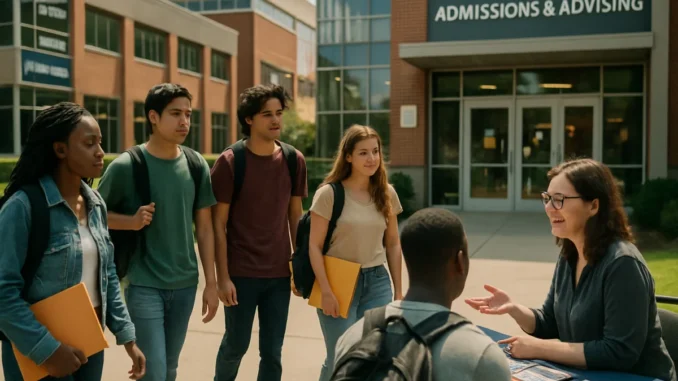
More U.S. high school graduates are choosing community college after graduation, a shift driven by lower costs, faster access to job credentials, and the option to transfer later to a four-year school. Recent studies from the National Student Clearinghouse Research Center and the American Association of Community Colleges show renewed enrollment gains at two-year institutions as families reconsider the price of a bachelor’s degree and the risks of taking on debt.
Why the two-year path is gaining ground
Community colleges have long served students who want an affordable start, but the appeal has widened as tuition, housing, and borrowing costs have climbed. The College Board’s Trends in College Pricing shows that published tuition and fees at public two-year colleges remain far below those at public four-year schools, giving graduates a clear financial reason to stay local.
That cost gap matters more when families are comparing outcomes. Students increasingly ask whether they need to pay four years of full university costs up front when an associate degree can lead to a job, a transfer path, or both.
The shift also reflects changing expectations about work. In many fields, employers now hire candidates with two-year credentials for roles in healthcare, information technology, advanced manufacturing, logistics, and skilled trades, according to labor market projections from the U.S. Bureau of Labor Statistics.
What the enrollment data show
National Student Clearinghouse Research Center data indicate that community college enrollment has been recovering after the sharp pandemic-era declines that hit much of higher education. The gains have not erased earlier losses, but they do show that two-year colleges are again competing for recent high school graduates.
The American Association of Community Colleges says the sector educates nearly 10 million students each year, making it a major entry point into higher education. For many students, the attraction is not only price but also flexibility. Local campuses, evening classes, online options, and part-time schedules make it easier to keep working while enrolled.
Dual enrollment has also changed the pipeline. More high school students now earn college credits before graduation, which can make a community college feel like a continuation rather than a detour. For students who already have some credit in hand, the associate degree path can look more efficient than starting at a four-year school from scratch.
Workforce needs are pushing the trend
Employers have helped strengthen the case for two-year degrees. Hospitals, clinics, utilities, manufacturers, and public agencies increasingly recruit from community colleges because the schools can train workers quickly and locally.
That is especially true in fields where labor shortages persist. The Bureau of Labor Statistics continues to project above-average demand in healthcare support, registered nursing, computer support, and several skilled trades, areas where community colleges often provide the core credential.
Some colleges have responded by expanding short-term certificates and stackable programs that let students earn credit toward an associate degree while moving into work faster. That model appeals to graduates who want a payoff sooner, even if they later decide to continue their education.
Transfer remains the critical test
The rise in community college interest does not automatically mean students are abandoning four-year degrees. Many high school graduates still view the two-year route as a cost-saving first step, not a final stop.
That distinction matters because transfer quality can determine whether the strategy saves time and money. Researchers and state agencies have repeatedly found that students can lose credits when moving between institutions, especially when advising is weak or degree maps are unclear.
Some states have improved articulation agreements and guaranteed transfer pathways, but the system remains uneven. If a student completes general education requirements at a community college and then has to repeat classes at a university, the financial advantage narrows quickly.
Colleges that pair clear transfer plans with career advising are likely to benefit most from the trend. Students who understand exactly how their credits will apply are more likely to stay enrolled and finish.
What this means for students and the industry
For students, the rise in community college enrollment signals a more pragmatic approach to higher education. Many families are choosing flexibility, lower debt, and faster workforce entry over the traditional assumption that a four-year campus is the default option.
For the industry, the trend could reshape how colleges compete. Community colleges may need more seats in high-demand programs, better scheduling, stronger advising, and closer employer partnerships. Four-year institutions may need to defend their value by showing clearer job outcomes, stronger transfer agreements, or more affordable first-year options.
Employers also have a stake in what happens next. If community college enrollment keeps rising, businesses that depend on skilled labor may find a larger pipeline of job-ready candidates. But that will depend on whether local colleges can scale programs without sacrificing completion rates or transfer quality.
The next phase to watch is whether these enrollment gains hold if economic conditions change, whether state funding follows demand, and whether more colleges turn associate degrees into reliable on-ramps to both work and a bachelor’s degree.