
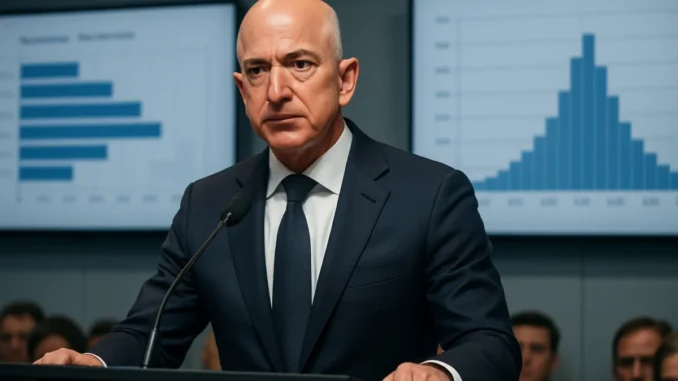
Amazon Executive Chairman Jeff Bezos on Wednesday called for zero federal income taxes on the bottom half of earners, placing a high-profile billionaire at the center of a recurring fight over tax fairness and who should carry the federal burden. The proposal would relieve lower-income households of federal income tax liability while pushing more of the load onto higher earners and underscoring how little many Americans already pay after credits and deductions.
Context
The federal income tax is only one piece of the U.S. tax system. Workers also pay payroll taxes, and many households face state and local sales taxes, so zero federal income tax would not mean zero taxes overall.
That distinction matters because the federal income tax is already highly progressive. IRS data show the top 1% of filers paid roughly 46% of federal individual income taxes in 2021, while the Tax Policy Center has found that many households in the bottom half owe little or nothing in federal income tax after credits such as the Earned Income Tax Credit and Child Tax Credit.
What Bezos is saying
Bezos did not present a full legislative blueprint, but the thrust of his statement was clear: lower earners should keep all of their income from federal income tax. In practical terms, that would formalize a structure in which the bottom half of households either pay no income tax or pay a very small amount after deductions and credits.
Supporters of that approach argue that the tax code should protect households with the least financial cushion. They say low- and moderate-income workers are more exposed to inflation, rent increases and uneven wages, making take-home pay more valuable than additional federal revenue from those households.
Critics of the idea point out that the federal budget still needs financing. If the bottom half paid zero federal income tax, Congress would have to rely even more heavily on upper-income filers, capital gains and corporate taxes, or else cut spending elsewhere.
The idea also raises a technical question that often gets lost in the political debate: the phrase bottom half is not a fixed category. Household income, individual earnings and tax-filing status do not always line up, so identical workers can end up in different tax positions depending on family structure, benefits and geography.
Why the data matter
Tax analysts say it is important to separate income taxes from total taxes. The Congressional Budget Office has repeatedly found that federal taxes and transfers reduce inequality overall, but payroll taxes still take a larger share of wages from lower earners than income taxes do.
That helps explain why proposals to eliminate federal income tax for lower earners can sound sweeping while changing less than they first appear. For many households near the bottom of the income scale, federal income tax liability is already small or nonexistent, while payroll taxes and state and local taxes remain a significant share of pay.
Bezos entering that debate also matters politically. Billionaires rarely advocate explicitly for a narrower federal income tax base, and when they do, the issue quickly shifts from tax mechanics to questions of fairness, inequality and whether the current system should be judged by income taxes alone or by the full tax-and-transfer picture.
Implications
For readers, the immediate takeaway is that a call for zero federal income taxes on the bottom half is less a radical break from the status quo than a sharper version of a system that already taxes low earners lightly in many cases. The larger question is who would make up the revenue gap if such a policy ever moved from rhetoric to legislation.
For the broader tax debate, Bezos’ comment is a reminder that the next fight is likely to center on burden shifting rather than simple rate changes. What to watch next is whether lawmakers, economists or other business leaders pick up the idea and turn it into a concrete proposal, and whether any plan addresses the revenue that would have to be replaced.