
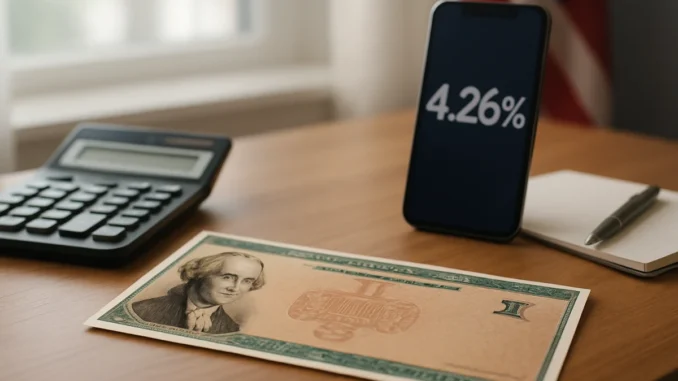
The U.S. Department of the Treasury announced on April 30, 2026, that Series I savings bonds will carry a 4.26% composite rate for the next six months, covering bonds issued from May 1 through October 31, 2026. The move gives U.S. savers a government-backed inflation hedge at a time when price pressures have cooled but remain uneven, with the calculation tied to inflation data tracked by the Bureau of Labor Statistics and published through TreasuryDirect.
How the rate works
Series I bonds are built to protect purchasing power, not to maximize returns. TreasuryDirect says each bond combines a fixed rate, set by the Treasury, with a variable inflation adjustment that resets every six months based on changes in the nonseasonally adjusted Consumer Price Index for All Urban Consumers, or CPI-U.
That structure makes the product different from a bank savings account or a Treasury bill. The inflation piece rises and falls with consumer prices, while the fixed rate stays attached to the bond for its life, which can stretch up to 30 years. For buyers, that means the headline 4.26% rate is only the starting point for a bond bought in this issuance window.
Why the new rate matters
A 4.26% rate is not a windfall, but it is meaningful for cash that can stay parked. The product remains one of the few federally backed retail savings tools that directly adjusts for inflation, giving it a niche in a market where many deposit accounts still fail to keep up with rising prices once inflation is factored in.
The timing also matters. Treasury’s announcement arrives after the inflation shock that pushed I bonds into the spotlight in 2022 and 2023, when households looked for safe places to preserve savings. Historical TreasuryDirect data show the bond’s appeal surged when consumer prices spiked, and the current rate suggests the program is still relevant even as inflation has eased from those highs.
For conservative savers, the bond works best as a defensive parking place rather than an income generator. Investors chasing yield can usually find higher returns in riskier markets, but those options expose principal to price swings, credit risk, or interest-rate risk. I bonds trade those upside possibilities for stability and inflation protection.
What buyers give up
The tradeoff is liquidity. TreasuryDirect says I bonds cannot be redeemed during the first 12 months after purchase, and anyone who cashes out before five years forfeits the last three months of interest. That makes the product a poor fit for emergency funds that may be needed quickly.
Purchase limits also keep the bond from becoming a large-scale wealth vehicle. Buyers can purchase up to $10,000 electronically each calendar year, with an additional $5,000 available in paper form through a federal tax refund. Those caps reinforce the bond’s role as a retail savings tool rather than a wholesale market instrument.
Data points behind the decision
The inflation component of the rate is not a guess. It is calculated from CPI-U data produced by the Bureau of Labor Statistics, which measures monthly changes in categories such as shelter, food, energy, and transportation. If those prices accelerate again, the next I bond reset could climb. If they stay subdued, the rate could drift lower.
That dependence on official inflation data gives the Treasury a simple but rigid formula. It also means the bond serves as a public barometer for how the government sees retail inflation risk over the coming six months. The 4.26% figure signals a market environment that is less volatile than the inflation surge, but still uncertain enough to justify protection.
Implications for savers and the market
For readers, the message is straightforward. I bonds make sense for money that will not be needed for at least a year and that should retain value if inflation surprises to the upside. They are less useful for short-term spending, rate chasing, or anyone who wants easy access to cash.
For the broader savings market, the Treasury’s update keeps pressure on banks and online deposit providers to compete on yield and liquidity at the same time. If consumer prices remain steady, the next reset in November 2026 could produce a lower number. If inflation turns back up, Treasury’s 4.26% offer may look modest in hindsight, and that is the main thing to watch next.