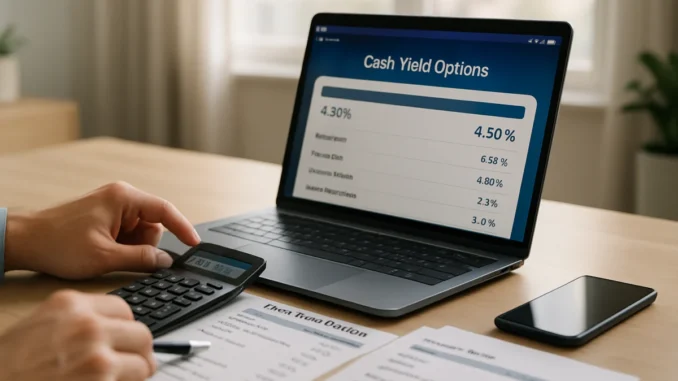
U.S. savers comparing bank and brokerage cash options are seeing slightly lower yields in May 2026, according to a nationwide monthly survey checked on May 14, 2026. The review covers high-yield savings accounts, Treasury bills, money market funds and cash-like ETFs, and it shows that the highest headline APY still reaches 4.40%, but most competitive savings accounts have slipped below 4%, while short-term Treasury bills are yielding about 3.7% and five-year CDs and Treasurys are both near 4.1%.
Context: why cash rates matter now
Cash management has become a bigger part of personal finance as online banks, brokerages and credit unions compete for deposits and idle balances. Consumers can often improve returns without taking on much additional risk by moving money among FDIC-insured banks or NCUA-insured credit unions, which each insure eligible deposits up to $250,000 per depositor, per ownership category, per institution.
The challenge is that not every high-rate offer is easy to use. Some accounts raise yield only for new customers, require high balances, or limit transfers in ways that matter for emergency funds and day-to-day liquidity.
Rate shopping also matters because cash rates can change quickly. A product that looks competitive one month can fall behind the next, especially when banks use teaser pricing or rely on customers who are unlikely to move their money.
High-yield savings accounts are still leading the pack
Among savings accounts, Pibank leads at 4.40% APY with no minimum balance, but the account comes with unusual transfer rules. Deposits can be made only through wire or Plaid, and withdrawals must also move by wire, which may limit flexibility for customers who want fast, low-cost access.
CineFi, a division of Southern Bancorp Bank, pays 4.34% APY with no minimum balance. OnPath FCU follows at 4.25% APY, although it requires a $25,000 minimum balance, which may put it out of reach for smaller savers.
CIT Platinum Savings holds at 3.75% APY for balances of $5,000 or more. The bank is also advertising a 4.10% APY boost for six months for customers who open an account by May 31, 2026, illustrating how promotions can temporarily lift returns before resetting lower.
SoFi Bank is paying 3.30% APY, according to the survey. That is still well above many megabank accounts, which continue to pay near zero, but it trails the leaders in the online savings market.
For consumers, the spread between accounts is not only about yield. Minimum balances, transfer rules, mobile access and customer service can matter just as much when the cash is meant to be available on short notice.
Treasury bills, CDs and cash-like funds offer different tradeoffs
Short-term Treasury bills remain a close substitute for savings accounts when the goal is to preserve principal and earn a modest yield. The survey puts short-term T-bill rates near 3.7%, while five-year Treasury yields are about 4.1%, roughly matching the top five-year CD rates.
Certificates of deposit sit between savings accounts and Treasurys. The five-year CD market is yielding around 4.1% APY, but early withdrawals can trigger penalties, so the higher rate comes with less flexibility than a savings account.
For taxpayers in states with high income taxes, Treasury interest can look stronger after taxes. TreasuryDirect says Treasury interest is taxable at the federal level but generally exempt from state and local income taxes, which can narrow the gap between Treasurys and bank products.
Money market mutual funds and money market ETFs also compete for cash, especially inside brokerage accounts. They can offer same-day or next-day liquidity and invest in short-term government or high-quality debt, but they are not FDIC-insured deposits.
The SEC notes that these funds are securities, not bank accounts, so investors should weigh liquidity, expense ratios and portfolio composition. Cash-like ETFs can be useful for disciplined parking of money, but their market prices can move during the trading day, which makes them less straightforward than an insured savings account for someone who may need to spend the money quickly.
What the May numbers mean for savers
The latest survey suggests that the search for yield is still worthwhile, but the margin for error is shrinking. A saver who ignores transfer fees, minimum balances, promotional expiration dates or tax treatment can lose more than the extra APY is worth.
The practical takeaway is to match the cash bucket to the time horizon. Emergency funds usually benefit from easy access and deposit insurance, while money that can sit untouched for months may earn more in a Treasury bill, a CD or a competitive money market fund.
Financial institutions are likely to keep using headline rates to win deposits, but consumers will need to look past the banner APY and read the fine print. The next shift to watch is whether online banks trim their offers again, and whether Treasury bill yields hold near current levels as the Federal Reserve’s policy path becomes clearer over the coming months.