
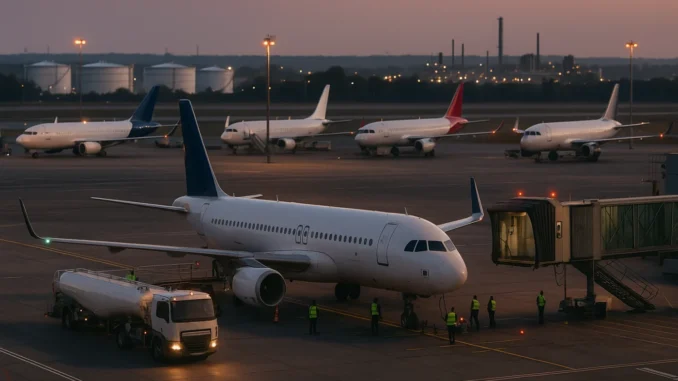
Europe could be headed for a jet fuel shortage within weeks, a supply squeeze that may force airlines to trim schedules or cancel flights just as the continent enters its busiest summer travel season. The risk is centered in Europe, where airlines, refiners, and fuel traders are watching inventories closely, and it is being driven by a mix of tight refining capacity, disrupted import flows, and seasonal demand growth that is arriving faster than supply can adjust.
Why the market is tightening
Jet fuel is a refined product, so shortages are rarely caused by one factor alone. In Europe, the problem reflects a thinner refining system than the region had a decade ago, plus a market that relies heavily on imports to cover demand spikes.
Analysts have pointed to several pressures at once: refinery maintenance, lower diesel-oriented refining output, and competition for cargoes from other regions. As airlines ramp up flights for summer, the market has less room to absorb disruptions, especially if inventories are already below seasonal norms.
Europe’s energy system has also been reshaped since Russia’s invasion of Ukraine in 2022, which disrupted established fuel trade patterns. The International Energy Agency has noted that Europe has had to replace lost Russian energy supplies with longer and more expensive supply chains, increasing exposure to shipping delays and freight costs.
What airlines are watching
For airlines, jet fuel availability matters as much as price. If local supply becomes scarce, carriers may have to tanker fuel on board from other airports, reroute refueling plans, or pay premiums to secure deliveries at congested hubs.
Those workarounds are costly and limited. Airlines already face high labor costs, a still-tight aircraft delivery pipeline, and strong summer demand that leaves little flexibility in operations. If fuel supply constraints spread beyond one airport or one country, carriers may have to cut frequencies or cancel less profitable routes first.
That scenario is especially sensitive in Europe, where short-haul networks depend on high aircraft utilization. A single canceled rotation can ripple across an entire daily schedule, leaving crews and aircraft out of position for later flights.
How a shortage could affect fares and schedules
Consumers would likely feel the impact in two ways. The first is through fewer available flights, which tends to push up fares on busy routes. The second is through disruption, as airlines protect the most profitable flights and reduce weaker ones if fuel supply cannot be guaranteed.
Even if a shortage does not trigger a broad wave of cancellations, higher jet fuel costs can still pressure ticket prices. Fuel remains one of the largest operating expenses for airlines, and the price of jet fuel in Europe typically tracks crude oil, refining margins, and freight costs rather than just the headline oil benchmark.
According to IATA, fuel costs have historically accounted for roughly a quarter to a third of airline operating expenses in normal periods, though that share moves with oil prices and hedging results. In a tight market, airlines with weaker balance sheets or limited access to fuel hedges are more exposed than the largest network carriers.
Supply chains are part of the problem
Jet fuel is not only about refinery output. It also depends on the timing of cargo arrivals, port availability, storage capacity, and inland transport. A delay at one point in the chain can create shortages at major airports even when total regional supply looks adequate on paper.
That fragility has become more visible as Europe imports more refined products from the Middle East, India, and the United States. Longer shipping routes create more opportunity for bottlenecks, and disruptions in global tanker markets can move fuel prices quickly.
Refinery outages matter too. When a plant goes offline for maintenance or an unexpected repair, the market must find replacement barrels fast. If several refineries are down at the same time, the regional system can move from balanced to strained in a matter of days.
Industry signals and expert views
Market traders have been signaling concern through narrower supply premiums and firmer prompt prices for jet fuel relative to later-month contracts. That pattern usually indicates buyers are paying more to secure immediate delivery, a common warning sign in physical fuel markets.
Energy analysts say the biggest risk is not a continent-wide collapse in supply but localized shortages at major hubs. London, Paris, Frankfurt, Amsterdam, and Mediterranean gateway airports could all face pressure if delivery schedules slip or if airlines rush to lock in cargoes before peak demand.
Airlines and fuel suppliers are also under pressure from regulators and investors to improve resilience without raising costs too sharply. The balance is difficult: holding more inventory reduces shortage risk, but it ties up working capital and can be expensive in a volatile market.
What this means for travelers and the travel industry
For travelers, the immediate risk is disruption rather than a total collapse in service. The most likely outcome is a narrower margin for error, with airlines becoming more selective about which routes they keep if fuel supply stays tight into peak season.
For the airline industry, the episode is a reminder that fuel security is now a strategic issue, not just a pricing issue. Europe’s dependence on imported refined products leaves carriers exposed to global logistics, refinery outages, and geopolitical shocks that can land quickly and last longer than expected.
What to watch next is whether inventory levels improve before the summer travel surge, whether refiners can bring capacity back online on schedule, and whether airlines begin cutting capacity at specific airports. If the market stays tight through the next several weeks, flight reductions and fare increases would become more likely across Europe’s busiest leisure and business routes.