
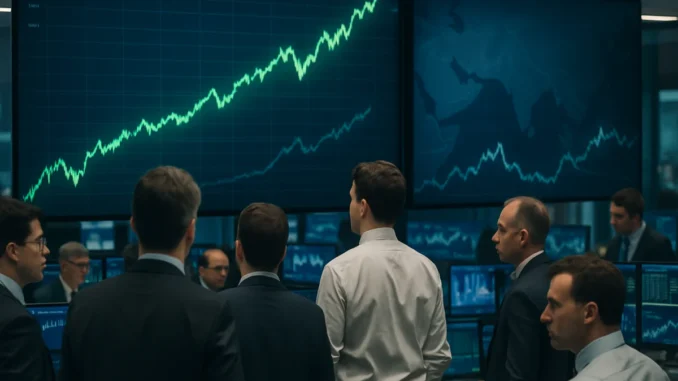
U.S. stocks pushed to new records on Wall Street this week, with the S&P 500 closing at an all-time high even as the war involving Iran showed little sign of easing and oil supply disruptions continued. Investors appeared to be betting that the conflict would stay contained, that global energy flows would not be broken, and that corporate earnings, liquidity, and large-cap technology strength would keep the rally intact.
Why investors are looking past the conflict
Markets often absorb geopolitical shocks faster than the headlines suggest. In this case, traders are separating the chance of disruption from the scale of disruption, and so far the damage has not reached the level that would alter the earnings outlook for most U.S. companies.
That distinction matters because a sustained hit to oil supply would feed into inflation, consumer spending, and Federal Reserve policy. Instead, investors have mostly seen a risk premium in energy markets, not a full-scale economic shock.
The backdrop: oil, inflation, and the Strait of Hormuz
The key transit route remains the Strait of Hormuz, where the U.S. Energy Information Administration says roughly one-fifth of the world’s petroleum liquids consumption passes through. Any lasting threat to that corridor would raise shipping costs, tighten supply, and likely push crude prices sharply higher.
But a move in oil is not the same as a lasting macroeconomic shock. As long as tanker traffic keeps moving and major export terminals stay online, investors can treat the conflict as a headline risk rather than a structural break.
That is one reason equities have stayed firm while energy markets have wobbled. Crude can jump on fear, but stocks usually need a clear path from geopolitics to profits before they break trend.
What is still driving the stock market
The rally is also being powered by factors that have little to do with the Middle East. Strong earnings from large technology companies, expectations of eventual interest-rate cuts, and steady institutional demand have kept money flowing into equities.
The S&P 500 is heavily weighted toward mega-cap firms whose profits depend more on cloud spending, software, advertising, and artificial intelligence than on fuel costs. That index mix makes the benchmark less sensitive to a regional war than a market dominated by airlines, industrials, or transportation names.
At the same time, investors who sold early on fear of escalation have often been forced to buy back in. That pattern, known as dip-buying, has helped push major indexes higher even when the news flow turns darker.
Volatility measures have also stayed relatively contained compared with past crisis periods. When options traders do not rush to price in a broader meltdown, equity markets tend to keep giving benefit of the doubt to the base case rather than the worst case.
Expert views and market signals
Analysts say the market’s reaction reflects a simple calculation: no supply shock, no panic. Energy strategists have warned that the real danger is not the first attack or retaliation, but a broader response that damages oil infrastructure, blocks shipping lanes, or triggers sanctions that pull more barrels out of circulation.
Market data supports that reading. When geopolitical events do not spill into long-duration supply losses, volatility often fades quickly and equities recover once traders decide the macro impact will be limited. That has been the pattern so far, with oil firming but not enough to drive a broad selloff in U.S. stocks.
The bond market has also remained orderly. When conflict risk begins to threaten growth, investors usually run toward Treasurys and push yields lower. That has not turned into a crisis signal this time, which suggests traders are still balancing the war against a broader story of slowing but not collapsing growth.
For now, the burden remains on bears to prove that the conflict will hurt corporate margins, consumer demand, or the Fed’s path. Without that proof, the stock market has chosen resilience over fear.
What it means for investors and the market
The immediate implication is that geopolitical risk is still being priced as a temporary shock, not a new regime. That leaves stocks vulnerable if events escalate, but it also means the market can keep climbing as long as the conflict stays geographically contained and energy exports remain largely intact.
For readers, the lesson is that record highs do not mean risk has disappeared. They mean investors currently believe the war’s economic damage will be limited, at least for now, and that earnings growth and rate expectations matter more than conflict headlines.
What to watch next is straightforward: tanker routes through the Strait of Hormuz, any strike on regional oil infrastructure, and whether crude prices climb enough to alter inflation expectations. If those lines hold, Wall Street may keep shrugging off the war. If they break, the market’s calm could disappear fast.